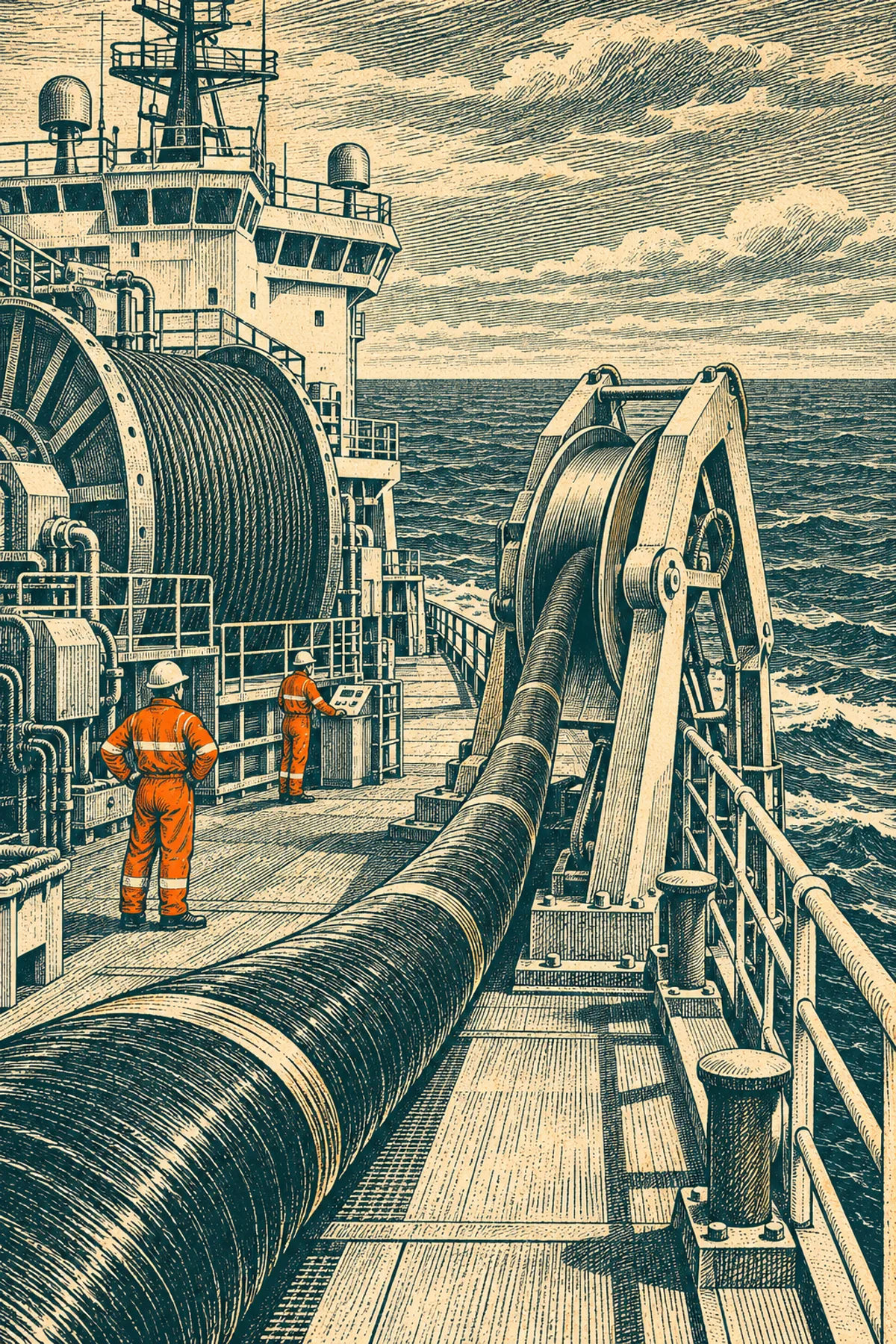
A household at the end of a dirt road wants broadband. Elon Musk wants a city on Mars. How do those two people end up on opposite sides of the same transaction? In January 2015, before Starlink had a single paying subscriber, Musk gave an audience in Seattle his answer. The satellite business, he said, was intended to “help fund a city on Mars.” The customer could buy a better connection without having the slightest interest in space exploration.
That is the most interesting sense in which Musk has a plan. Build a capability a distant ambition will require. Find a customer who needs that capability now. Use each delivery to improve the hardware, the factory or the network for the next attempt. Call the things people buy along the way by-products if you like. To the person making a video call, the connection is the whole product.
The rocket has a customer before it leaves the pad
A Mars programme has a difficult first sale. There is no established passenger market on the other end. Earth orbit is different. Satellite operators need a ride. NASA buys crew transport. Starlink needs regular launches to build and renew its network. Those missions exercise the rockets and give the teams more chances to learn how to launch, recover and fly again. Government procurement belongs in the story too. NASA has paid for capabilities that commercial customers can subsequently use.
In its third-quarter 2026 results, SpaceX reported that Starship delivered 26 next-generation Starlink satellites on a single flight. SpaceX estimated that the mission added roughly ten times the downlink capacity of one Falcon 9 Starlink launch. That measures network capacity delivered, rather than a tenfold increase in any one subscriber’s speed. The launch customer and the launch provider sit inside the same company. The people buying service at the far end supply the outside demand. By 30 September, Starlink had 13.6 million consumer subscribers. The broader connectivity segment earned roughly $2.37 billion in operating profit that quarter. That is evidence that one piece pays today. It cannot tell us how much of any one subscription was allocated to Mars.
The technology now reaches beyond a dish bolted to a roof. T-Mobile offers satellite connectivity for compatible phones outside terrestrial coverage. SpaceX sells secure communications for governments through Starshield. A hiker with a coverage gap and a defence ministry have different requirements. Both create work for launch vehicles and satellite factories. A crewed Mars settlement remains an ambition, and NASA still requires demonstrations for its lunar lander programme.
The first Tesla buyer wanted a sports car
Musk had described a version of this bargain before. Tesla’s early plan was to sell an expensive electric sports car, use the proceeds to move downmarket, and offer clean power alongside the vehicles. What carried forward was more than money. Getting a battery pack to survive years on the road, building cars in volume and making charging convenient were problems engineers could solve for paying drivers. An owner got a car. Tesla got a factory, a customer base and a list of things to fix in the next generation. The company later absorbed SolarCity, bringing generation closer to storage and use.
Follow the battery out of the car. A household can buy a Powerwall to keep the lights on. A utility can buy Megapacks to move electricity from a time of surplus to a time of need. A truck operator can buy a Semi for freight. Even SpaceX is a customer for Tesla’s large batteries. There is a genuine commercial connection here, although the filings identify the buyer more precisely than the final destination of each unit. It would be a leap to assign every one to an AI data centre.
Now follow the ability to perceive and act. Tesla sells supervised driving software, is deploying purpose-built Cybercabs in its Austin robotaxi fleet, and says production-quality Optimus robots have begun coming off its Fremont line. Cars, cabs and humanoid robots all need to interpret a changing environment and act safely in it. Success on a road does not settle how reliably a robot will handle a warehouse shift. The next meaningful proof for Optimus is a customer repeatedly paying for useful work.
Even a rival can buy the machinery
This is where the picture stops looking like a collection of consumer brands. Twitter became X. X and xAI came under a common parent in 2025. SpaceX acquired that parent in February 2026 and subsequently bought Cursor. Grok gives users an AI assistant. X gives it a place to reach an audience. Cursor puts AI inside a developer’s working day. X Money extends the X brand into payments, returning Musk to territory he knew from his early PayPal days. A payments product is evidence of that ambition. It does not demonstrate that customer accounts, messages and AI training data are pooled across the group.
The less obvious product is time on a machine. Anthropic says it agreed to use the entire capacity of SpaceX’s Colossus 1 data centre to expand access to Claude. A developer can prefer Claude to Grok and still create demand for Musk’s infrastructure. That is a particularly telling test of the thesis. A rival has its own reasons to buy, independent of Musk’s vision.
Two larger bets follow. Tesla and SpaceX are pursuing Terafab to secure chips for demanding applications. SpaceX’s Starmind proposal would put AI computing aboard satellites and relay results through its network. Reusable rockets, satellite communications and computing would then be parts of one service. What has to be demonstrated is the cost of delivering useful computing over a satellite’s lifetime, including launch, cooling, maintenance limitations and replacement. A design and a target date leave that question open.
Where the connections get thinner
The Boring Company sells an immediate benefit in Las Vegas: a ride through a tunnel. The route gives people a reason to use the infrastructure while its builders learn to dig and operate it. SpaceX also discloses an equity interest in the tunnelling company. Neuralink has a different test altogether. Its PRIME feasibility study asks whether a surgically implanted interface can help people with severe paralysis control external devices. A patient gaining the ability to operate a computer is a meaningful outcome in its own right. The trial does not establish mass adoption or a commercial link to Mars. Musk founded both ventures, but the public evidence supports different degrees of connection.
Who else gets a say?
Customers help pay for development. They also become dependent on things the operator controls. In February 2026, Ukraine’s defence ministry described working with SpaceX to authorise Starlink terminals and prevent Russian forces using unverified equipment. For Ukrainians depending on those links, access to a private network was a matter of national defence. In Europe, the Commission opened an inquiry into how X assessed risks from Grok’s deployment and widened its scrutiny of recommender systems. One case shows the value of cooperation. The other asks who answers for the consequences of combining distribution and AI.
Musk has also spent money on American elections through America PAC and served as a special government employee in the Trump administration. These are concrete reasons people scrutinise his influence. They do not prove that political access determined a particular contract. Nor do the customer revenues prove that customers cover the whole undertaking. SpaceX’s filings show substantial external financing, and both Tesla and SpaceX have set up committees to examine a possible combination. Who owns what, how the assets are valued and who bears the risk are still live questions.
So why does Musk provoke such a strong reaction? For some people it is his politics. Others see a danger in concentrating communications, transport and computing under one leader. And is there, for some of us, a little jealousy or even fear in watching somebody take one useful piece of a decades-long ambition and turn it into something people willingly pay for today? Motives differ. The commercial test is easier to see. A family can get online, a developer can run a model and a government can buy a launch, all before anyone has bought a ticket to Mars.
Love him or hate him, that part of his plan is working.
Watch the film
English captions available in the player. Artwork is illustrative.
Sources & further reading 25 links
- Seattle speech
- NASA mission record
- SpaceX on Mars
- SpaceX Q3 results
- T-Mobile satellite service
- NASA lander update
- Musk’s 2016 plan
- Tesla’s corporate history
- Tesla Q3 field report
- Tesla Q3 filing
- Tesla’s 2025 plan
- X and xAI ownership filings
- SpaceX Q3 filing
- X Money product guide
- Anthropic’s account
- Tesla shareholder letter
- Starmind project
- Vegas Loop routes and fares
- Clinical trial register
- Neuralink research updates
- Ukraine’s defence ministry
- EU inquiry
- Campaign finance reporting
- White House transcript
- GPU financing announcement
Source material and reporting are dated. This archive preserves the original editorial work; it is not a live news feed.
Our editorial approach